Why Parenting Feels So Overwhelming From Back to School to the Holidays

The stretch from August to January can feel like one long group project where somebody keeps adding new assignments, and somehow the parent is always the project manager.
One week, it is school supply lists, new shoes, forms, and pickup routines. Then come picture day, spirit week, fundraisers, conferences, class parties, Halloween costumes, Thanksgiving travel, winter performances, teacher gifts, family gatherings, holiday cards, gift lists, and the question of how to pay for all of it.
For young families, the season is not simply “busy.” It can feel relentless. The calendar fills up, the expenses rise, and the emotional pressure grows louder. Parents want their kids to feel included, loved, and excited. They also need to work, cook, clean, budget, sleep, and stay connected to each other.
That is a lot for one season to hold.

The season asks parents to switch roles all day long
Back-to-school season comes with a mental reset. Summer schedules, even when chaotic, often have a different rhythm. Then school begins, and everything gets more exact.
There are start times, pickup lines, lunch rules, dress-up days, sign-up forms, portal logins, and emails from teachers. A parent may go from packing snacks to joining a work call, then checking homework, then paying a school fee, then figuring out what the child needs to wear for “crazy sock day.”
None of these tasks is huge on its own. The overwhelm comes from the constant switching.
A parent is expected to be:
The family calendar keeper
The budget tracker
The memory maker
The snack manager
The costume planner
The emotional support person
The driver
The gift buyer
The person who knows where everything is
That kind of role-switching drains attention. It also creates the feeling that there is no clear finish line. Even after the kids are in bed, the brain keeps scanning for what comes next.
Did the permission slip get signed? Is the costume still at the store? Who needs a gift? Are the grandparents expecting a visit? What day is the school performance? Did anyone RSVP?
This is one reason Parenting can feel so heavy during this time of year. The work is not only physical. Much of it is invisible, and invisible work is hard to share unless it is named out loud.
The pressure to make everything special has grown
Many parents remember simpler holiday seasons from childhood, or at least they seem simpler in memory. A costume came from a closet. A holiday meal involved a few familiar dishes. Gifts were exciting, but the expectations felt different.
Now, parents often feel surrounded by examples of “special.” Matching pajamas. Perfectly themed birthday parties. Elaborate teacher gifts. Professional-looking class treats. Costume reveals. Holiday photos. Daily traditions. Carefully wrapped presents under a coordinated tree.
Even when families are not trying to keep up, the ideas are everywhere. School communities, neighborhood events, family text threads, and online spaces can make normal family life feel unfinished.
The pressure is not always direct. No one may say a parent has to do more. Still, the message can feel clear: a good parent makes the season magical.
That belief is exhausting.
Children do not need every event to be a production. They often remember small, repeated moments more than the polished ones. Pancakes on a Saturday morning. A favorite movie. Driving through a neighborhood to see lights. A parent sitting on the floor to help tape together a cardboard costume.
Special does not have to mean expensive, elaborate, or photo-ready. It can mean familiar. It can mean calm. It can mean everyone gets through the night without rushing.
For families in places like Santee or Temecula, where fall school calendars can overlap with sports, local events, family visits, and long drives across Southern California, the pressure to attend everything can build fast. The warm weather can also make the season feel less defined. It may be October, but the calendar says pumpkins, while the temperature still says playground and popsicles.
That mismatch can make the holiday rush feel like it arrives before anyone is ready.

Rising costs make every decision feel heavier
The emotional load of the season gets harder when money feels tight. Many families are dealing with higher grocery bills, child care costs, gas prices, rent or mortgage pressure, and the everyday expenses that come with growing kids.
Then seasonal costs arrive.
A few dollars here and there can become a long list:
School supplies and classroom donations
New clothes or shoes
Fall sports or activity fees
Halloween costumes and candy
Thanksgiving food or travel
Holiday outfits or photos
Teacher gifts
Family gifts
Wrapping supplies
Extra groceries for gatherings
End-of-year tips or donations
The hard part is that many of these expenses come with emotion attached. Parents are not just buying candy. They are trying to help a child feel included. They are not just buying a gift. They are trying to show love. They are not just buying food. They are trying to honor tradition.
That makes it harder to say no.
It also makes small financial decisions feel personal. A parent may wonder if skipping one event means disappointing a child. Choosing a smaller gift budget may bring guilt, even when it is the wise choice. Saying no to travel may feel like letting extended family down.
This is where the season can tip into Holiday Burnout. It is not only fatigue from doing too much. It is fatigue from caring deeply while having limited time, money, and energy.
A helpful shift is to decide on limits before the most intense weeks arrive. Limits feel less painful when they are planned instead of made in a moment of stress.
For example:
Set a gift range early.
A smaller, clear budget is easier to manage than a vague goal to “keep it reasonable.”
Choose one or two anchor traditions.
Maybe the family always bakes cookies, visits one light display, or watches one favorite movie. Everything else can be optional.
Create a “no guilt” skip list.
Some events will not happen this year. Naming that ahead of time helps reduce the sense of failure.
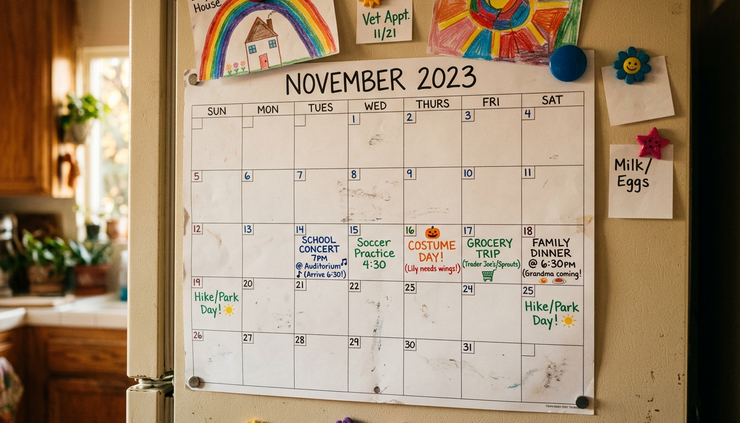
Use the calendar as a truth teller.
If two school events, a family visit, a work deadline, and a birthday party all land in one week, something may need to go.
A full calendar is not proof of a full childhood. Kids also need quiet evenings, regular meals, and parents who are not running on empty.
Family expectations can turn the season into a negotiation
The holidays often bring love, connection, and tradition. They can also bring pressure.
Young parents may be trying to build their own family rhythm while also meeting expectations from parents, in-laws, siblings, and relatives. Everyone may want time together. Everyone may have a preferred date, meal, gift routine, or tradition.
For parents with young children, travel and gatherings are not simple. Nap schedules, car seats, bedtime, overstimulation, food needs, and meltdowns are real. A “quick visit” can take hours of packing, driving, unloading, supervising, and recovering.
Family members may not see that work. They may only see the answer.
Can you come to dinner?
Can you bring a side dish?
Can you stay later?
Can you stop by one more house?
Can you make sure the kids dress up?
Can you take a family photo?
Each request may come from a good place. The total can still be too much.
Clear boundaries help, especially when they are simple and repeated without over-explaining.
Try language like:
“We can come from 2:00 to 5:00, then we need to head home.”
“We are keeping gifts simple this year.”
“We are not traveling that weekend, but we would love to see you another day.”
“We can bring rolls or drinks, but we cannot cook a full dish this time.”
“The kids will wear what is comfortable.”
The goal is not to convince every person. The goal is to give clear information and protect the family’s capacity.
If possible, parents should decide these limits together before responding to relatives. A united answer lowers stress and prevents one parent from becoming the default messenger.
Kids feel the rush too
Adults often think of seasonal stress as an adult problem. Kids feel it in their own way.
A packed season can mean later bedtimes, more transitions, sugar-heavy events, crowded rooms, long car rides, and big expectations to behave well in unfamiliar settings. Some children get excited and loud. Others get clingy, irritable, or tearful. Some seem fine during the event and fall apart at home.
That does not mean parents did anything wrong. It means the child’s system is full.
When families build in recovery time, the whole season becomes more manageable. Recovery does not need to be fancy. It can be an open morning, a quiet dinner at home, or an early bedtime after a big event.
A simple rhythm helps:
Before the event
Tell kids what to expect. Keep it short. “We are going to the school party. We will stay for one hour. Then we will come home for dinner.”
During the event
Watch for signs of overload. Some kids need a break outside, a snack, or a quiet corner.
After the event
Lower demands. A child who held it together at a party may not be ready to clean their room or answer lots of questions right away.
Parents need recovery too. After a loud gathering or a long school night, it is reasonable to keep the next evening simple. Leftovers count. Pajamas at 6:30 count. Saying no to one more thing counts.
A lighter season starts with fewer automatic yeses
Many parents do not choose an overwhelming season all at once. It happens through automatic yeses.
Yes to the volunteer slot.
Yes to the extra gift exchange.
Yes to the long drive.
Yes to hosting.
Yes to matching outfits.
Yes to one more event because it sounds fun and everyone else is going.
A lighter season often starts by pausing before the yes.
Ask three questions:
Does this matter to our child or our family, or does it only feel expected?
What will this cost in time, money, and energy?
What would we have to give up to make room for it?
The last question is the most useful. Every yes takes space from something else. Rest, dinner at home, a calmer bedtime, a free weekend morning, or money set aside for a real need.
This does not mean families should cut all the fun. The season can still hold joy, community, and tradition. Many school events and holiday gatherings are meaningful. Kids can love them. Parents can love them too.
The difference is choosing with care.
A family might decide:
One school night event per week is enough.
One holiday outing matters more than five rushed ones.
Gifts will focus on a few thoughtful items.
Extended family visits will happen on separate days, not all in one marathon.
The kids can repeat outfits.
Store-bought treats are fine.
A simple costume is still a costume.
These choices may feel small, but they protect the emotional climate of the home. A calmer parent often matters more than a fuller calendar.

The takeaway families need most right now
This season feels overwhelming because it asks for more than most parents can easily give. It compresses school demands, social plans, family expectations, emotional labor, and extra spending into a few short months.
The answer is not to become more organized until every minute is accounted for. The answer is to protect what actually matters.
Kids need connection more than perfection. Parents need rest more than another obligation. Families need room to enjoy the season, not just complete it.
Pick the few things that matter most. Put them on the calendar. Let some of the rest be smaller, later, simpler, or skipped.
A good season is not one where everything gets done. It is one where the family makes it through with love still intact.
We'd love to help lower your holiday parent stress this year. We are accepting new patients. Call today to get scheduled.



Comments