Healthy Boundaries or Avoidance? How to Communicate Clearly Without Evasion

A boundary can protect your peace. Avoidance can protect your discomfort. From the outside, the two can look almost the same.
You decline a dinner invitation. You stop replying to late-night texts. You tell a coworker you cannot take on one more task. You leave a conversation before it turns into an argument.
Any of those choices could be healthy. Any of them could also be a way to dodge a needed conversation.
The difference matters because boundaries are part of self-care, while avoidance often keeps stress alive in the background. A healthy boundary says, “This is what I need in order to stay well and respectful.” Avoidance says, “I do not want to feel the discomfort of being honest.”
Both usually come from a real need. The goal is not to judge yourself for avoiding hard moments. The goal is to notice the pattern, understand what is driving it, and learn how to communicate boundaries clearly without disappearing, deflecting, or hoping the other person “gets the hint.”

Healthy boundaries are clear limits that protect your well-being
A boundary is a limit you set around your time, energy, body, emotions, values, or responsibilities. It helps define what is okay for you and what is not.
Healthy boundaries can sound like:
“I can talk about this, but I’m not willing to be yelled at.”
“I need at least a day’s notice before making plans.”
“I care about you, but I cannot be your only support.”
“I’m not available to answer work messages after dinner.”
“I do not want comments about my body.”
Boundaries are not punishments. They are not threats. They are not a way to control another person’s choices. They are a way to name what you will do, accept, or participate in.
That distinction is key.
A controlling statement tries to manage someone else:
“You are not allowed to talk to me that way ever again.”
A boundary focuses on your response:
“If the conversation includes yelling or insults, I will pause it and come back when we can speak respectfully.”
The other person still has choices. You have choices too.
Healthy boundaries often support self-care because they reduce resentment, burnout, emotional overload, and confusion. Without boundaries, people may say yes while feeling no. They may overextend, keep quiet, then become distant or angry later. Over time, that pattern can damage relationships more than a direct conversation would have.
A boundary gives the relationship better information. It tells the truth sooner.
Avoidance tries to escape discomfort instead of addressing the issue
Avoidance is the act of sidestepping a conversation, decision, feeling, or conflict because it feels uncomfortable, risky, overwhelming, or unfamiliar.
Avoidance can look like:
Ignoring a message because you do not know how to say no
Canceling plans repeatedly instead of saying you need space
Acting “fine” while building resentment
Changing the subject whenever money, intimacy, parenting, or conflict comes up
Being vague so the other person has to guess what you mean
Ending a relationship in your mind before having an honest conversation
Avoidance is human. Most people do it at times, especially when they grew up around anger, criticism, people-pleasing, or unpredictable reactions. If honesty once led to punishment, rejection, or ridicule, avoiding conflict may have become a survival skill.
But a survival skill can become a relationship barrier.
Avoidance may bring short-term relief. The uncomfortable moment passes. No one gets upset right now. You do not have to risk being misunderstood.
Yet the issue usually remains. It may even grow. The other person senses distance but does not know why. You may feel guilty, tense, or trapped. Small irritations can turn into quiet scorekeeping.
A helpful question is:
Am I creating a clear limit, or am I trying to avoid the discomfort of being known?
That question is not always easy to answer. Sometimes you need space before you can speak clearly. Taking time to calm down is not the same as avoidance. The difference is whether you come back to the conversation.

The difference often comes down to honesty, timing, and follow-through
Boundaries and avoidance can overlap in confusing ways. Both might involve space. Both might involve saying no. Both might feel tense.
The difference is usually found in three areas: honesty, timing, and follow-through.
Healthy boundary | Avoidance |
Names the limit clearly | Keeps the real issue hidden |
Protects well-being while staying respectful | Reduces discomfort by escaping the conversation |
Includes what you will do next | Leaves the other person guessing |
Allows room for dialogue when safe | Shuts down dialogue without explanation |
Creates clarity over time | Creates confusion over time |
Consider these examples.
A friend keeps venting for hours
A healthy boundary might be:
“I care about what you’re going through, and I can listen for about 20 minutes tonight. After that, I need to rest.”
Avoidance might be:
You stop answering their calls for weeks, then feel irritated when they keep trying.
The boundary protects your energy and gives your friend clear information. Avoidance may protect your evening, but it leaves the relationship unclear.
A partner raises their voice during conflict
A healthy boundary might be:
“I want to keep talking, but I won’t continue while we’re yelling. I’m going to take a 30-minute break, and then I’d like to try again.”
Avoidance might be:
You leave every hard conversation and never return to the topic.
The boundary creates a safer way to continue. Avoidance ends the discomfort but prevents repair.
A coworker keeps asking for last-minute help
A healthy boundary might be:
“I can’t take this on today. In the future, I need more notice if you want help with a deadline.”
Avoidance might be:
You say “maybe,” then hope they forget, then feel resentful when they follow up.
The boundary is direct. Avoidance turns your no into a guessing game.
A family member comments on your choices
A healthy boundary might be:
“I’m not discussing my finances at family gatherings. If it comes up again, I’ll step outside or change the subject.”
Avoidance might be:
You skip every family event without telling anyone why, even though part of you wants connection.
The boundary protects your privacy. Avoidance may protect you from discomfort, but it can also isolate you from relationships you still value.
Of course, some situations are not emotionally or physically safe. If direct communication could put someone at risk, distance may be necessary. Safety comes first. In unsafe dynamics, support from a trusted person, therapist, advocate, or crisis resource can help you plan carefully.
Clear boundaries use direct language without overexplaining
Many people avoid boundaries because they imagine the conversation will be harsh. But clear does not have to mean cruel. Kindness and firmness can exist in the same sentence.
A helpful boundary often includes three parts:
A brief acknowledgment
A clear limit
A next step or consequence you control
For example:
“I understand this matters to you. I’m not able to talk tonight. I can check in tomorrow after work.”
That sentence is short, respectful, and specific. It does not attack the other person. It also does not hide.
Use “I” statements that describe your limit
“I” statements work best when they are honest and grounded in your own behavior.
Try:
“I’m not available for calls after 9 p.m.”
“I need time to think before I answer.”
“I’m not comfortable discussing that.”
“I can help for one hour, but I can’t stay all afternoon.”
Avoid using “I feel” as a disguise for blame.
Less helpful:
“I feel like you’re selfish.”
“I feel like you never respect me.”
More helpful:
“I feel overwhelmed when plans change at the last minute. I need more notice.”
The second version gives the other person something clear to understand.
Say what you mean without making the other person decode it
Hints often feel safer than directness, but they create confusion.
Hinting sounds like:
“I guess I’m just really tired lately.”
“Must be nice to have so much free time.”
“Some people don’t understand personal space.”
Clear communication sounds like:
“I’m not up for visitors this weekend.”
“I need you to ask before borrowing my car.”
“Please don’t tease me about that.”
When people have to decode your boundary, they may miss it. They may also feel manipulated or blindsided later when resentment shows up.
Avoid long courtroom explanations
Overexplaining can be a sign that you do not believe your boundary is valid unless the other person approves it.
You can offer context, but you do not have to build a legal case.
Clear:
“I can’t host this year. I need a quieter holiday.”
Too much:
“I know I hosted last year, and I know everyone likes my house, and I know it might be inconvenient, but work has been stressful, and I’ve been tired, and I don’t want anyone to think I’m being selfish…”
The longer version may invite debate. The shorter version is easier to hear.
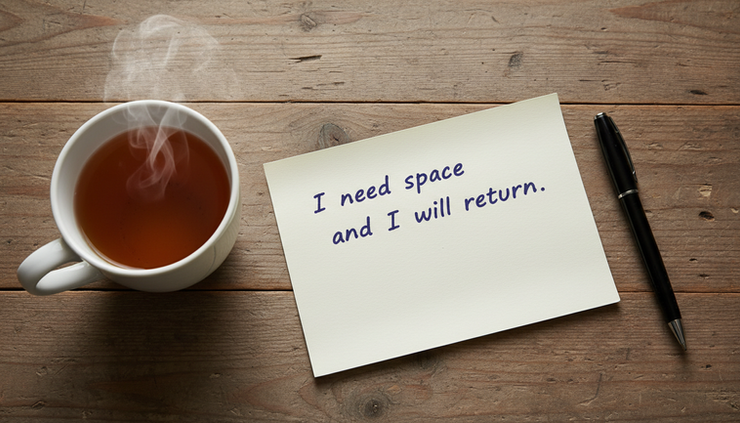
Return to the conversation when you ask for space
Taking space is one of the most misunderstood boundaries. It can be healthy, especially during anger, anxiety, or overload. But it becomes avoidance when there is no plan to return.
Try saying:
“I’m too upset to talk productively. I’m going to take a walk and come back in 45 minutes.”
“I need to sleep on this. Can we talk tomorrow after dinner?”
“I want to answer honestly, and I need some time to sort out my thoughts.”
This gives both people clarity. You are not vanishing. You are regulating yourself so the conversation can go better.

Common signs that a boundary may actually be avoidance
It can be hard to tell whether you are protecting yourself or hiding from discomfort. These signs can help you pause and reflect.
You may be avoiding if:
You feel relief at first, then guilt or dread later
You hope the other person figures it out without you saying it
You tell other people the issue but not the person involved
You repeatedly delay a conversation with no clear plan
You use busyness as your only explanation
You feel resentful, but you keep saying yes
You cut off contact quickly in situations that might be repairable
You rehearse the conversation often but never have it
You may be setting a healthy boundary if:
You can name what you need and why
Your limit is tied to your well-being or values
You communicate directly when it is safe to do so
You allow the other person to respond, even if they are disappointed
You follow through calmly
You feel steadier over time, not more entangled
One useful test is to ask, “What am I trying to protect?”
If the answer is “my sleep,” “my recovery,” “my emotional safety,” “my time with my kids,” or “my ability to speak respectfully,” a boundary may be needed.
If the answer is “my image,” “my comfort,” “my fear of disappointing someone,” or “my wish to avoid any reaction,” avoidance may be in the mix.
That does not mean you are doing something wrong. It means there is useful information there.
Therapy can help with this distinction because boundary patterns often have roots in family roles, past conflict, trauma, anxiety, or low self-trust. A therapist may help you practice language, notice people-pleasing, and build tolerance for uncomfortable but safe conversations. This is one way to understand How therapists help with Boundaries in real life, not as a script, but as a process of building clarity and confidence. People may also search for Therapists help with boundaries setting when they want support turning insight into actual conversations.
This article is for general information and reflection. It is not a substitute for mental health care, crisis support, or safety planning.
A simple practice for communicating without evasion
Boundary-setting gets easier with practice. Start with lower-stakes situations before tackling the hardest relationship in your life.
Use this short process.
Pause before you respond
If you tend to say yes too quickly, give yourself a buffer.
Try:
“Let me check and get back to you.”
“I need a little time before I answer.”
“I’m not sure yet. I’ll let you know by Friday.”
A pause is not avoidance if you actually follow up.
Name the real limit
Ask yourself:
What exactly is not working for me?
What do I need more or less of?
What am I willing to do?
What am I not willing to do?
What happens if this continues?
Be specific. “I need respect” is valid, but broad. “I need conversations without name-calling” is clearer.
Choose one sentence you can actually say
Do not aim for the perfect speech. Aim for one honest sentence.
Examples:
“I can’t lend money, but I hope you find support.”
“I’m not ready to talk about that yet.”
“I want to spend time together, and I need plans to be made in advance.”
“I’m happy to help with dinner, but I’m not able to host overnight guests.”
Let disappointment exist
A boundary does not guarantee that the other person will feel happy. They may be disappointed, frustrated, or surprised.
That does not mean the boundary is wrong.
Clear communication allows both people to have their own experience. You can care about someone’s feelings without making those feelings your responsibility to fix.
Follow through with calm consistency
A boundary without follow-through becomes a request.
If you say you will leave the room when insults start, leave the room when insults start. If you say you do not answer work texts after dinner, do not keep answering them “just this once” every night.
Follow-through does not need to be dramatic. It works best when it is steady.
Reflect on the pattern, not just the moment
The next time you feel the urge to withdraw, say yes while tense, or shut down a conversation, pause and look beneath the surface.
Ask yourself:
Am I protecting my well-being, or avoiding discomfort?
Have I clearly communicated what I need?
Am I expecting someone to guess my limit?
Is this relationship safe enough for a direct conversation?
What would I say if I trusted that my needs were valid?
What pattern do I want to change, even if it feels awkward at first?
Healthy boundaries make relationships more honest. Avoidance often makes them more confusing. The difference is not perfection. It is the willingness to be clear, respectful, and accountable when communication gets uncomfortable.
A good next step is to choose one small boundary you have been avoiding. Write it in one sentence. Remove the extra apology, the blame, and the long defense. Then decide when and how you will communicate it.
Clarity may feel uncomfortable at first, but it often brings relief that avoidance never can.
If you would like more support on boundary setting, we'd love to help! Give us a call at 619-549-0329 to begin today!



Comments