When Work Anxiety Follows You Home Understanding the Sunday Scaries Every Day
You close your laptop, walk away, make dinner, put on a show, and somehow your brain is still in a meeting that ended four hours ago.
That’s the part people don’t always get about work stress. It doesn’t politely stay at work. It follows you into the grocery store, into your group chat, into your bed at 11:47 p.m. when you suddenly remember an email you forgot to answer.
The classic Sunday Scaries get talked about like a one-night event. Sunday evening hits, the weekend starts slipping away, and Monday begins to feel way too close. But for a lot of people, that feeling doesn’t wait for Sunday. It shows up on Tuesday after a weird Slack message, Friday night after a tense check-in, or Saturday morning when your phone buzzes and your stomach drops.
If anxiety feels intense, constant, or hard to manage, talking with a mental health professional at Grow Through Life Counseling can help.

Why work anxiety follows you after hours
Work takes up a huge amount of mental space. Even when the tasks are simple on paper, the hidden load can pile up fast.
There’s the actual work, then there’s everything around the work:
Reading tone in short messages
Wondering if your manager is annoyed
Trying to prove you’re reliable
Keeping track of deadlines
Switching between tasks all day
Feeling pressure to be available
Comparing yourself to coworkers
Worrying about layoffs, rent, debt, or health insurance
That’s a lot for one nervous system to carry.
When the day ends, your brain may still be trying to “solve” everything. It reviews conversations, replays mistakes, and scans for future problems. That can look like productivity, but it often turns into rumination. You’re not planning anymore. You’re looping.
Work Anxiety can also stick around because modern work has blurry edges. A decade or two ago, leaving work often meant physically leaving the building. Now your job can live in your pocket. Even if you don’t open email, you know you could. That tiny possibility keeps part of your brain on call.
This is especially true if your workplace has unclear expectations. If no one says when it’s okay to log off, people start guessing. And guessing usually turns into worst-case thinking.
Maybe this sounds familiar:
You get a message at 5:58 p.m. that says, “Can we talk tomorrow?” No context. No emoji. Just six words.
Your logical brain says, “It’s probably fine.”
Your anxious brain says, “I’m getting fired.”
Then the rest of your night becomes evidence gathering. Did your manager seem weird earlier? Did you mess up that spreadsheet? Was your camera off too much this week? Suddenly, one vague message owns your entire evening.
That reaction doesn’t mean you’re dramatic. It means your brain is trying to protect you from uncertainty. The problem is that it can’t always tell the difference between a real threat and an uncomfortable unknown.
Signs your job is taking over your downtime
Not all after-work stress is a problem. Some days are just rough. If a big deadline is coming up, it makes sense to think about it after hours. The issue is when work starts taking over moments that are supposed to refill you.
Here are some signs the stress has crossed into your personal time.
You can’t enjoy rest without feeling guilty
You sit down to relax and immediately feel like you should be doing something useful. Laundry. Meal prep. Email. Career planning. Updating your resume. Learning a new skill.
Rest starts to feel “earned” only after you’ve completed an impossible list.
That mindset can make even a normal night feel tense. You’re technically off, but you’re still measuring your worth by output.
You keep checking work apps without needing to
You open your email out of habit. You check Teams or Slack while watching TV. You refresh a project board before bed, not because anything urgent is happening, but because not checking feels worse.
This can train your brain to expect work interruptions at any time. After a while, silence stops feeling peaceful. It feels suspicious.
Your body reacts before your thoughts catch up
Sometimes your body notices anxiety first.
You might feel:
Tightness in your chest or jaw
A stomach drop when a notification appears
Headaches after work
Trouble falling asleep
Waking up already tense
Feeling tired but wired
The body can hold the stress of the day even when you tell yourself you’re “fine.”
You replay conversations for hours
A quick comment from a coworker becomes a whole courtroom scene in your head.
“What did they mean by that?”
“Was I too quiet?”
“Did I sound rude?”
“Should I message them to clarify?”
This is exhausting because there’s no finish line. You can analyze the same conversation 15 different ways and still not feel certain.
Your mood changes before the next workday
If your mood drops every evening because tomorrow is coming, that matters. The Sunday Scaries can turn into a daily pattern when each night feels like a countdown.
You might notice you’re more irritable, withdrawn, distracted, or numb. You might cancel plans because you “just need to recover,” then spend the whole night thinking about work anyway.

Why your brain treats an email like danger
Work stress can feel confusing because the trigger is often tiny. A message. A calendar invite. A missed call. A sentence that seems harmless to someone else.
But anxiety isn’t only about the size of the trigger. It’s about what the trigger represents.
A short email can represent getting judged. A meeting invite can represent conflict. A delayed response can represent rejection. A mistake can represent losing stability.
For many young adults, work is tied to survival in a very real way. Rent is high. Groceries cost more than they used to. Health insurance may depend on employment. Career paths can feel shaky. So when something feels “off” at work, your brain may connect it to bigger fears fast.
There’s also the pressure to be easy to work with. Many people learn early in their careers to say yes, respond quickly, and act calm even when they’re overloaded. That can help in the short term, but it can also teach your brain that being liked equals being safe.
Then after hours, you’re still managing an invisible performance.
Did you seem grateful enough?
Did you ask too many questions?
Did you answer too slowly?
Did you look engaged?
That kind of self-monitoring is draining. It also makes downtime feel unsafe because your brain keeps searching for signs that you messed up.
And if you work remotely or hybrid, the signals can be even harder to read. In person, you might notice that someone is just tired or distracted. Online, all you get is a period at the end of a sentence and a profile icon.
So your brain fills in the blanks. Usually not with the kindest explanation.
How to create a real end to the workday
You can’t always control workload, management style, or company culture. But you can build stronger edges around your time. Think of it as helping your brain understand, “We’re done for now.”
The goal isn’t to never think about work after hours. That’s not realistic. The goal is to stop work from automatically taking the best parts of your evening.
Start with a shutdown ritual
A shutdown ritual is a small routine that tells your brain the workday has ended.
Keep it simple. It might take five minutes.
Try this:
Write down the top three things waiting for tomorrow.
Check your calendar for the next day.
Send any final message that truly can’t wait.
Close every work tab.
Say out loud, “I’m done for today.”
That last part might feel silly. Do it anyway. Your brain responds to cues. A clear ending helps more than vaguely drifting away from work while still half-checking things.
Make tomorrow less mysterious
A lot of after-hours anxiety comes from uncertainty. You don’t need to solve tomorrow tonight, but you can reduce the blank space.
Before logging off, write a short “tomorrow list.” Not a fantasy list with 18 tasks. A real one.
For example:
Reply to Maya about the report
Finish the first draft by 2 p.m.
Ask Jordan about the missing numbers
Take lunch away from the screen
This gives your brain a place to land. When the thought pops up later, you can say, “That’s already on the list.”
Put friction between you and work apps
Willpower is overrated when your phone is glowing from across the room.
Add friction instead.
You could:
Turn off work notifications after a set time
Move work apps off your home screen
Use app limits in your phone settings
Charge your phone outside the bedroom
Log out of work email on weekends
Set a status that says when you’ll reply
You don’t need to disappear or become unreachable if your job requires some after-hours coverage. But if it doesn’t, don’t train people to expect instant access to you all night.
Boundaries work best when they’re boring and repeatable. The less dramatic they feel, the easier they are to keep.
Use your body to change the channel
Thinking your way out of anxiety doesn’t always work. Sometimes your body needs proof that the threat has passed.
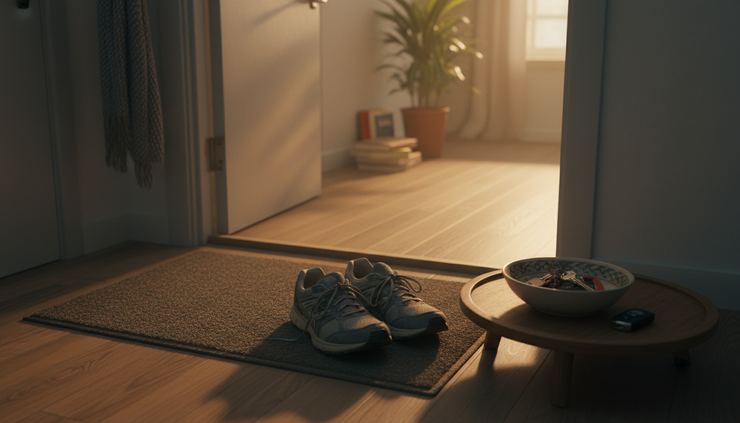
After work, try something physical but low-pressure:
Take a 10-minute walk
Stretch on the floor
Shower and change clothes
Cook something simple
Do a quick room reset
Step outside without your phone
This isn’t about becoming a wellness influencer. It’s about giving your nervous system a new environment, new sensory input, and a reason to stop scanning for work problems.
A walk around the block can be more helpful than lying in bed trying to force yourself to calm down.
Create a worry window
If your brain insists on worrying, give it an appointment.
Pick 10 to 15 minutes earlier in the evening. During that time, write down every work worry with no editing. Then sort each one into two groups.
Can act on
Can’t act on tonight
Send a message tomorrow, ask a question, check a deadline, update a task list
Someone’s tone, future layoffs, whether people are secretly upset, a mistake already addressed
For anything you can act on, write the next step. For anything you can’t act on tonight, practice saying, “This is not solvable right now.”
That phrase may not make the worry vanish. That’s okay. The win is not obeying every anxious thought like it’s an emergency.
When the problem is bigger than your coping skills
Personal habits help, but they don’t fix everything. Sometimes anxiety follows you home because the workplace is unhealthy.
If your job regularly includes unclear expectations, last-minute emergencies, public criticism, pressure to be online all the time, or punishment for setting reasonable limits, the issue may not be your stress tolerance.
It may be the environment.
That doesn’t mean quitting tomorrow is the only answer. Most people can’t just walk away from a paycheck. But naming the problem clearly matters.
Ask yourself:
Do I know what success looks like in my role?
Are deadlines realistic most of the time?
Can I ask questions without feeling stupid or unsafe?
Do people respect time off?
Is urgency used for everything, even when it’s not urgent?
Have I changed in ways I don’t like since taking this job?
If the answers feel heavy, start documenting patterns. Save unclear messages. Track after-hours requests. Write down dates when expectations changed suddenly. This can help if you need a conversation with a manager, HR, a mentor, or a Grow Through Life Counseling therapist.
Also, talk to someone outside the work bubble. Anxiety grows when it only has your own thoughts to bounce around in. A friend, partner, roommate, sibling, or counselor can help reality-check the story your brain is telling.
Try saying something plain:
“I keep feeling anxious after work, and I can’t tell if this is normal stress or if something’s off.”
That kind of sentence opens a better conversation than pretending everything is fine until you burn out.

A calmer evening starts with one clear boundary
You don’t need to overhaul your life tonight. You don’t need a perfect routine, a color-coded planner, or a totally new personality.
Start with one boundary that makes your evening feel like yours again.
Maybe it’s no work email after 7 p.m. Maybe it’s a shutdown note at the end of each day. Maybe it’s putting your phone in another room during dinner. Maybe it’s asking your manager, “What counts as urgent after hours?”
Small boundaries count because they teach your brain a new pattern. Work can matter without taking over every quiet moment. You can care about doing a good job without being mentally available all the time.
The feeling may not disappear overnight. That’s normal. Anxiety often gets louder at first when you stop feeding it constant checking and reassurance. But with practice, the evenings can start to feel less like a waiting room for tomorrow and more like actual time you get to live in.
Tonight, pick one thing that marks the end of work. Close the tab. Write the list. Take the walk. Let one message wait.
You’re allowed to be off the clock in your own mind, too.
We are accepting new patients and would like to help you with Sunday Scaries or any work anxiety. Give us a call today 619-549-0329 to get started.



Comments